A copper-peptide product can have a plausible biological rationale without having demonstrated the particular benefit a shopper expects. Faster recovery, less redness, fewer wrinkles, and greater satisfaction are separate claims. A study measuring several of them may produce different answers without being internally contradictory. The useful question is not simply whether copper peptides worked, but which comparison supports which conclusion—and how precisely the study estimated it.
The directly relevant clinical evidence here concerns topical glycyl-L-histidyl-L-lysine copper, or GHK-Cu, used after laser treatment around the mouth. This analysis uses the indexed primary report abstract for that study and the laboratory papers, together with an author-posted full-text OCR of a separate diabetic-ulcer trial. These are different levels of access and different experimental settings. Read together, they support a careful assessment of aftercare evidence, not a ranking of retail products or an assumption that wound biology translates directly into everyday facial benefits.
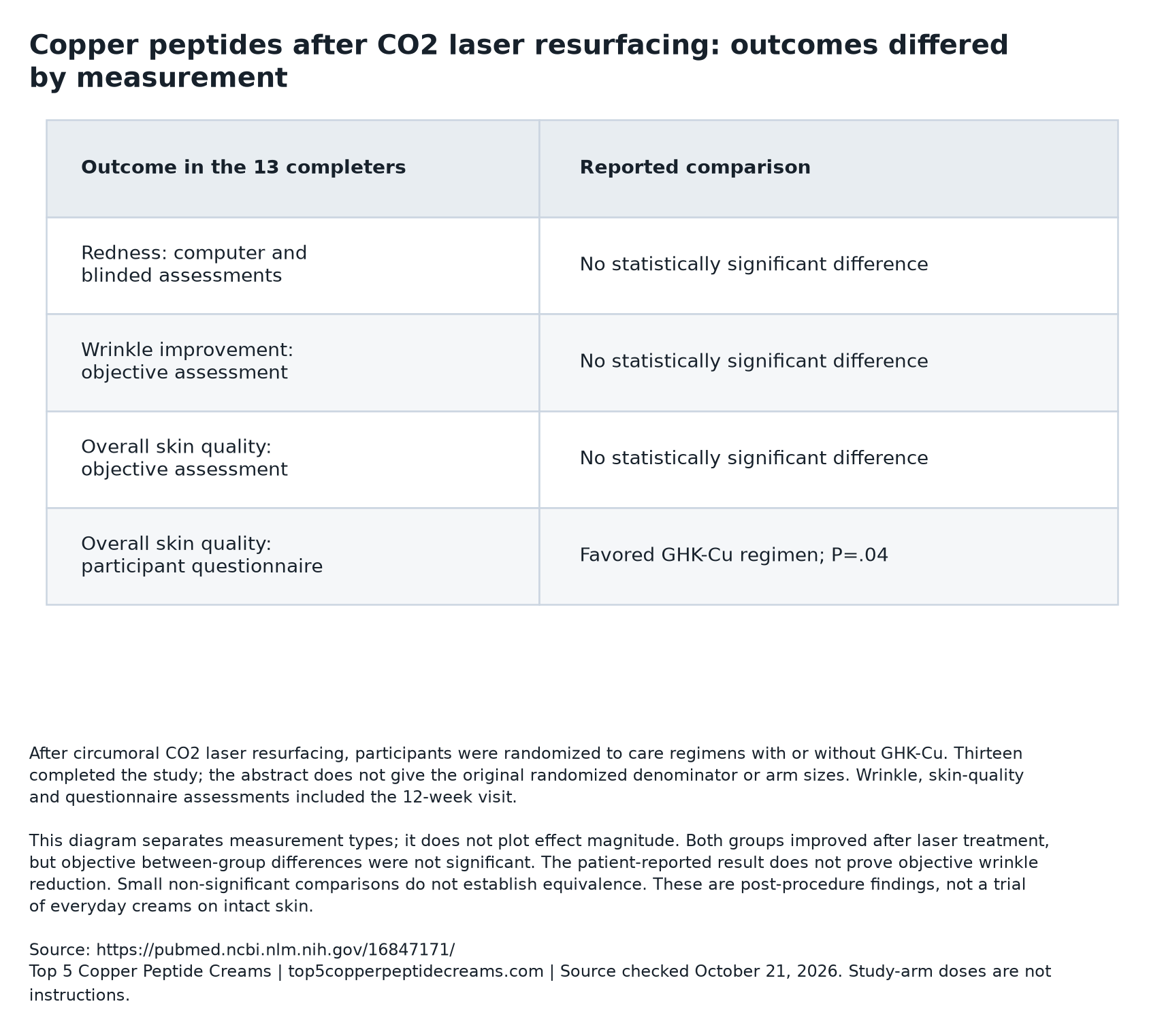
Study facts at a glance
- Laser-study design: Patients were randomized to post-CO2 circumoral resurfacing regimens with or without GHK-Cu; 13 completed the study. [1]
- Objective comparison: Redness, wrinkles, and overall skin-quality assessments showed no statistically significant between-group differences. [1]
- Patient-reported finding: The questionnaire favored GHK-Cu for perceived overall skin-quality improvement, with P = .04. [1]
- Different clinical setting: The ulcer trial enrolled 181 people overall; its favorable immediate-treatment plantar-ulcer results do not describe all participants. [2]
- Mechanistic evidence: Fibroblast experiments investigated collagen production and matrix remodeling, not cosmetic effectiveness in people. [3] [4]
The comparison was an addition to laser aftercare
The laser intervention was shared background treatment, not the experimental difference between groups. That distinction defines the causal question: did adding the copper-containing regimen improve recovery or appearance beyond the comparison regimen? Improvement after an effective procedure cannot, by itself, establish the value of an accompanying product. The appropriate test is the difference between otherwise comparable groups, rather than whether either group looks better afterward.
Random assignment helps reduce systematic differences between groups at entry. Blinded assessments can reduce the influence of an evaluator’s expectations. Neither feature guarantees a precise answer, especially when few observations are available. The indexed abstract does not report enrollment, randomized arm sizes, attrition details, product concentration, or a designated primary endpoint. Consequently, readers cannot reconstruct the complete analysis population or determine which outcome had priority. The practical framework in how to read a copper-peptide study is useful here: first identify the experimental contrast, then the outcome, then the uncertainty. A product name or ingredient shared with another formulation is not a substitute for those details.
Measured appearance and patient experience answer different questions
The report used computer analysis and blinded evaluators for redness, assessed appearance at 12 weeks, and included a validated patient questionnaire. Those methods do not all measure the same underlying construct. An image-based measure asks about a defined visual feature. A patient rating asks how the person experiences or evaluates the result. Both can be relevant, but neither automatically validates the other.
As methodological interpretation, a questionnaire advantage could reflect aspects of treatment experience that an appearance scale misses. Alternatively, expectations, measurement variability, or chance could contribute. The abstract does not establish which explanation applies. It is therefore inappropriate either to dismiss the patient result as meaningless or to translate it into objectively faster healing. The table separates the claims each outcome could support. This distinction also prevents an overall favorable impression from being presented as proof that every measured feature improved.
| Endpoint | Scientific question | Interpretive boundary |
|---|---|---|
| Redness assessment | Does visible erythema resolve differently between regimens? | Does not measure every aspect of comfort or satisfaction. |
| Wrinkles and overall appearance | Is there an additional visible benefit beyond resurfacing? | Within-group improvement does not establish an additive product effect. |
| Patient questionnaire | Do participants perceive a better result? | A favorable rating does not establish a matching objective change. |
A nonsignificant comparison is not evidence of equivalence
Statistical significance is a decision rule, not a measurement of how similar two treatments are. A nonsignificant comparison may arise when the true difference is small, when measurements are noisy, or when the study provides too little information to distinguish plausible effects. These possibilities have different clinical meanings, yet all can produce the same significance label.
Equivalence requires a different design logic: investigators specify in advance how large a difference would matter and estimate whether the entire uncertainty interval lies within that boundary. The accessible laser report provides neither an equivalence margin nor effect estimates with confidence intervals. Calling the regimens equivalent would therefore answer a question the available report does not resolve. Likewise, nonsignificant between-group findings should not be described as values remaining unchanged over time. Participants can improve substantially in both groups while the incremental contribution of an add-on remains uncertain. For product comparison, the defensible conclusion is limited evidence for an additional measured benefit, not proof of zero biological activity or proof that every competing formulation performs identically.
The positive questionnaire result needs a magnitude
A P value does not tell a reader how much better patients felt. Its calculation concerns how compatible the observed data are with a specified statistical model under a null hypothesis. It is not the probability that a product works, the percentage of patients helped, or the probability that the finding will reproduce. A confidence interval and an interpretable questionnaire difference would contribute information that a significance threshold alone cannot supply.
Illustratively, a small shift on a broad satisfaction scale and a large shift could both cross a conventional threshold under different measurement conditions. Their practical importance would not be interchangeable. Because several outcomes were assessed, the analysis plan also matters: a prespecified main comparison carries a different interpretive role from one favorable result among many exploratory tests. Without the full laser report, the multiplicity strategy cannot be established. This is not grounds to invent an adjustment or declare the result false. It is a reason to treat the patient signal as worth investigating, while avoiding a strong claim about its size, reliability, or implications for visible recovery.
Ulcer evidence tests a different treatment environment
The separate randomized, evaluator-blinded ulcer study compared topical gel with vehicle alongside standardized wound care. Its immediate component used 2% gel for up to eight weeks followed by six weeks of observation; delayed components used four weeks of vehicle before eight further weeks with vehicle or 2% or 4% gel. These are historical study arms, not application instructions. The full-text narrative describes weekly wound-area measurement, whereas the laser trial addressed postprocedure redness and appearance.
The comparison matters because an intervention is more than its ingredient. Tissue condition, delivery vehicle, timing, accompanying care, and endpoint together define the tested treatment. A wound-area result does not become a wrinkle result merely because both experiments involve skin. Conversely, a limited cosmetic finding does not erase evidence from a clinically distinct wound setting. The companion analysis of the diabetic-ulcer study examines that population in greater detail. The useful synthesis is contextual: ask whether the proposed use preserves the experimental conditions necessary for the original comparison, rather than treating all topical copper products as one intervention.
| Evidence setting | Experimental comparison | What does not transfer automatically |
|---|---|---|
| Post-laser clinical study | Aftercare regimens with versus without GHK-Cu | Results for routine use on intact facial skin. |
| Diabetic-ulcer clinical study | GHK-Cu gel versus vehicle with standardized care | Cosmetic wrinkle outcomes or retail cream performance. |
| Collagen cell experiment | Fibroblast collagen response under laboratory exposure | Delivery to target cells through human skin. |
| Matrix-remodeling cell experiment | Fibroblast enzyme and inhibitor responses | Net tissue improvement or clinical safety. |
Wound-area percentages are not patient response rates
In the immediate-treatment plantar-ulcer comparison, median area closure was 98.5% with active gel and 60.8% with vehicle. Those medians describe wound-area change, not the percentages of people whose wounds healed completely. Subtracting them gives a 37.7-percentage-point difference between group medians; it does not reveal an individual patient’s likely benefit. A separate categorical healing endpoint addresses a different question.
For an illustrative calculation, a wound beginning at 200 square millimeters and ending at 40 has closed by 80% of its initial area. If it instead expands to 240, its closure value is negative 20%. Improvement is bounded at complete closure, while deterioration can extend below zero. That asymmetry helps explain why means and medians can tell different stories in wound studies. It also shows why a single summary should not be treated as a complete distribution of outcomes. The practical lesson extends to appearance research: a percentage must retain its denominator and its mathematical definition. Area reduction, participants responding, and relative speed are not interchangeable forms of efficacy.
Timing and missing observations shape the ulcer estimate
The ulcer endpoint used each participant’s last visit, not necessarily a common 14-week assessment. Longitudinal graphs carried the last observed value forward. Delayed-treatment comparisons did not show significant improvement over vehicle. These features matter because a study’s apparent treatment effect depends partly on when outcomes are observed and how departures from follow-up are represented.
Carrying an observation forward assumes, for analytical purposes, that its value can stand in for later unobserved measurements. That may be reasonable for some circumstances and less reasonable for others. A wound that has closed, one that is worsening, and one lost for an unrelated reason need not have the same future trajectory. Similarly, a before-and-after rate comparison becomes difficult if natural recovery changes speed over time. Interpretation should therefore separate treatment timing from proven mechanism: differing results across schedules do not by themselves establish why those schedules differed. This is also why preserving the clinical plan matters more than extrapolating a trial schedule into self-directed care. The postprocedure guide discusses that boundary without turning experimental exposures into recommendations.
Fibroblast experiments establish plausibility, not delivery
The collagen experiment reported stimulation in fibroblast cultures independent of a change in cell number. The remodeling experiment reported increased MMP-2 expression and increased secretion of TIMP-1 and TIMP-2; copper ions reproduced the MMP-2 effect, while GHK alone did not. MMPs are enzymes involved in matrix breakdown, and TIMPs inhibit metalloproteinases. Together these findings describe regulation of tissue remodeling, not simply accumulation of more collagen.
A mechanistic chain from a jar to a visible result has several links: the formulation must preserve relevant activity, deliver an exposure to the appropriate tissue, produce a useful cellular response, and improve an outcome people value. Cell culture addresses only part of that chain. Direct exposure in a culture dish does not establish penetration through intact skin, and enzyme expression does not establish a favorable net tissue result. Laboratory concentrations therefore should not become cosmetic dosing targets. The label-percentage guide and cream, gel, or balm comparison offer complementary ways to distinguish ingredient descriptions from demonstrated performance. Mechanistic evidence can justify better clinical experiments without settling which finished formulation deserves preference.
Safety reporting must stay tied to the studied population
The laser abstract gives no adverse-event counts, so it cannot support a quantified tolerability comparison. In the ulcer study, reported infection incidence was 7% versus 34% in the immediate-treatment plantar comparison, while overall adverse-event rates did not differ significantly across treatment groups. The narrower infection finding should not be expanded into general infection prevention or proof of safety.
Safety assessment asks different questions from efficacy assessment: what happened, how severe was it, when did it occur, and who remained under observation? An absence of a significant overall difference does not establish that two regimens have identical risks. Nor does a favorable event comparison in a selected wound population establish tolerability on recently resurfaced facial skin. The ulcer report documents ProCyte affiliations, an identified company product, and acknowledgment of its development team, but those relationships do not establish a particular grant or funding arrangement. The laser abstract does not identify a funder. Documentary transparency helps readers assess possible influences, while neither commercial involvement nor its absence substitutes for examining methods, missing data, and the completeness of harm reporting.
Product comparisons need a documented bridge to the experiment
The editorial implication is that trial evidence should constrain comparisons rather than decorate rankings. A defensible comparison would first ask whether a retail formulation matches the studied intervention closely enough to make the citation relevant. Route, vehicle, exposure, intended setting, and accompanying care all matter. The available clinical evidence does not automatically extend to compounded preparations, systemic injections, oral products, or a provider’s outcomes.
Readers checking commercial documentation can consult the CoreAge Rx review or NEOVA review for terms and disclosures; those links do not imply access to the studied intervention or equivalent clinical results. As editorial reasoning, any price premium attributed to faster recovery should be distinguished from a premium for texture, packaging, or personal preference. A stronger future trial would identify a main endpoint, report group differences and confidence intervals, account transparently for all randomized participants, and quantify harms. It could then assess patient experience alongside objective recovery without forcing either to stand in for the other. Until such evidence is available, specificity is more informative than a winner’s label.
What this evidence supports
The laser evidence supports a distinction between perceived benefit and demonstrated additional objective improvement, not a broad verdict on every copper-peptide product. Its strongest consumer lesson is methodological: match each claim to the endpoint actually tested, and do not mistake a significance label for an effect size. The ulcer study provides a separate clinical signal under specific wound-care conditions, while the fibroblast papers offer biological plausibility without establishing delivery or cosmetic outcomes. For Copper Index comparisons, these studies are better used to define evidentiary boundaries and research priorities than to award a formulation, brand, or provider a clinical ranking.
Research access and limitations
The laser and cell-study analyses rely on indexed primary abstracts, not reviewed full protocols or supplements. The ulcer analysis includes author-posted full-text OCR, but original table and figure layouts were not verified; ambiguous arm counts and categorical rates are therefore omitted. The ulcer abstract and full text describe the same trial, not independent replications. Missing laser effect estimates, confidence intervals, adverse-event counts, concentration, enrollment, arm sizes, attrition details, and funding information cannot be reconstructed from the accessible abstract.
Your questions, answered
Does the laser study show that copper peptides do nothing?
No. Failure to establish a significant between-group difference does not identify the true effect as exactly zero. The objective findings limit claims of demonstrated additional benefit, but the missing effect estimates and confidence intervals prevent a precise assessment of how much benefit or disadvantage remains compatible with the data. [1]
Should patient satisfaction count as scientific evidence?
Yes, when it is measured systematically. Patient experience can be an important outcome in its own right. The interpretive mistake is substituting it for a different endpoint, such as measured redness or wrinkle change. Ideally, a report explains the questionnaire scale, size of the difference, uncertainty, and whether the comparison was prespecified. [1]
Why not combine the laser and ulcer results into one effectiveness score?
Their populations, treatment environments, comparators, and outcomes are not interchangeable. Combining them into a single consumer score would conceal those differences rather than resolve them. They are more useful as complementary evidence about distinct questions: postprocedure appearance, clinical wound closure, and the conditions under which an intervention was tested. [1] [2]
Does evidence of collagen stimulation establish an anti-aging effect?
Not by itself. A cellular response is one step in a longer pathway to a clinical outcome. Delivery, tissue-level balance, durability, and visible benefit still require testing. Remodeling also involves breakdown and inhibition, so a single laboratory marker cannot describe the overall effect on skin structure. [3] [4]
What information would most improve confidence in a product comparison?
A clearly identified formulation tested against an appropriate comparator, a prespecified meaningful endpoint, complete participant accounting, effect estimates with confidence intervals, and systematic adverse-event reporting would be especially useful. Replication would help determine whether a favorable result is robust rather than peculiar to one small experiment or measurement approach. [1] [2]
Sources & further reading
Provider pages establish what a brand markets. Clinical and regulatory sources establish the limits of the evidence. Each source has its own last-checked date below.
- Miller et al.: copper complex after CO2 laser resurfacing2006 randomized study; 13 completers; procedure-specific context · Checked October 21, 2026
- Mulder et al., 1994: GHK-Cu in diabetic neuropathic ulcers (author-posted full text)Author-posted primary full-text OCR; original table and figure layout not verified · Checked October 21, 2026
- Stimulation of collagen synthesis in fibroblast cultures by the tripeptide-copper complex glycyl-L-histidyl-L-lysine-Cu2+.Indexed primary laboratory-study abstract · Checked October 21, 2026
- The tripeptide-copper complex glycyl-L-histidyl-L-lysine-Cu2+ stimulates matrix metalloproteinase-2 expression by fibroblast cultures.Indexed primary laboratory-study abstract · Checked October 21, 2026
- Enhanced healing of ulcers in patients with diabetes by topical treatment with glycyl-l-histidyl-l-lysine copper.Indexed primary study abstract · Checked October 21, 2026